
Publishing Scholarly Archaeology since 1997
Publishing Scholarly Archaeology since 1997
Log in | My Account | Basket Twitter Facebook LinkedIn
Advanced Search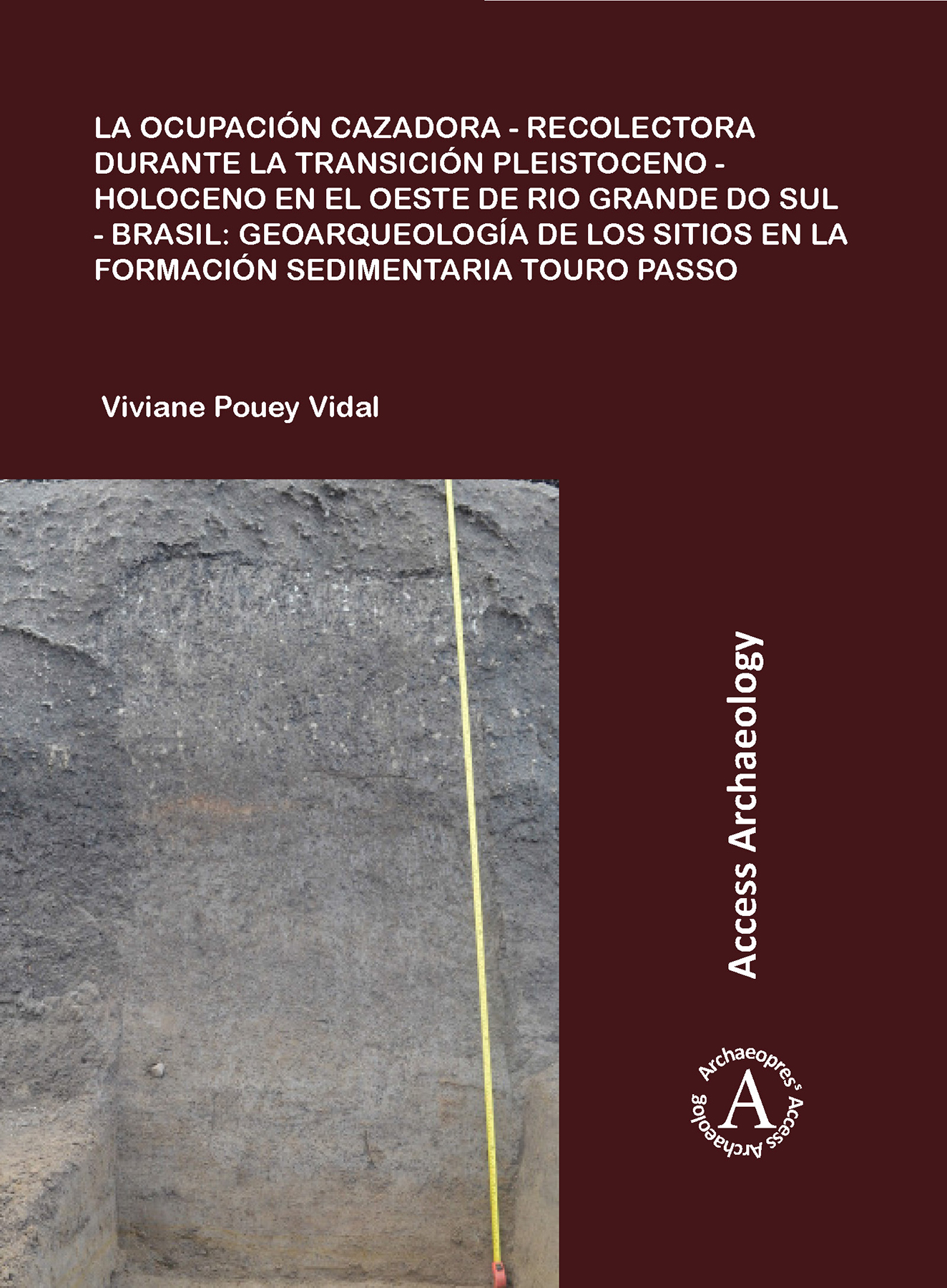
Download Sample PDF
H 276 x W 203 mm
260 pages
217 illustrations; 33 tables (119 colour plates)
Spanish text
Published Jul 2018
Archaeopress Access Archaeology
ISBN
Paperback: 9781784919139
Digital: 9781784919146
Keywords
Geoarchaeology; Sedimentary formation Touro Passo; Paleoindian Sites; Formation processes and post-depositional disturbance; Lithic taphonomy. Hunter-gatherers; Pleistocene-Holocene transition; Geoarqueología; Formación sedimentaria Touro Passo; Sitios Paleoindios
La ocupación cazadora-recolectora durante la transición Pleistoceno-Holoceno en el oeste de Rio Grande do Sul - Brasil: geoarqueología de los sitios en la formación sedimentaria Touro Passo

Paperback
£55.00
Includes PDF
PDF eBook
(personal use)
Free Download
PDF eBook
(institutional use)
£10.00
 Add to wishlist
This book presents the results obtained during geoarchaeological studies carried out in the locality of Touro Passo, Brazil. New chronologies obtained represent a scientific advance for the study of hunter-gatherer occupations during the Late Pleistocene-Early Holocene in the triple border of Brazil, Argentina and Uruguay.
Contents
CAPÍTULO 1. INTRODUCCIÓN; CAPÍTULO 2. ANTECEDENTES DE INVESTIGACIÓN; CAPÍTULO 3. MARCO GEOGRÁFICO Y AMBIENTAL DEL ÁREA DE ESTUDIO; CAPÍTULO 4. PALEOAMBIENTES, FAUNA PLEISTOCÉNICA Y VEGETACIÓN EN EL RIO URUGUAY Y ARROYO TOURO PASSO; CAPÍTULO 5. METODOLOGÍA; CAPÍTULO 6. PROSPECCIONES ARQUEOLÓGICAS EN LA CUENCA DEL RÍO URUGUAY Y EN LA SUBCUENCA DEL ARROYO TOURO PASSO: REUBICACIÓN Y UBICACIÓN DE NUEVOS SITIOS; CAPÍTULO 7. LOS SITIOS ARQUEOLÓGICOS EN LA FORMACIÓN SEDIMENTARIA TOURO PASSO: PROCESOS DE FORMACIÓN Y PERTURBACIÓN POSTDEPOSICIONAL; CAPÍTULO 8. EL ESTUDIO GEOARQUEOLÓGICO EN LOS SITIOS DEL RIO URUGUAY; CAPÍTULO 9. LOS CONJUNTOS ARTEFACTUALES DE LOS CAZADORES - RECOLECTORES EN LA TRANSICIÓN PLEISTOCENO - HOLOCENO:UN BREVE ANÁLISIS TAFONÓMICO Y TECNOLÓGICO; CAPÍTULO 10. DISCUSIONES DE LOS RESULTADOS; CAPÍTULO 11. CONCLUSIONES; BIBLIOGRAFIA
About the Author
Viviane Pouey Vidal has a PhD in Archaeology (Faculty of Social Sciences, UNICEN-National University of the Center of the Province of Buenos Aires-Olavarría). She is a researcher at the GEGAL - Group of Geoarchaeological Studies of Latin America. She was a PhD Fellow abroad by the CAPES - Coordination of Improvement of Higher Level Personnel. She acted as University teacher in the Interdisciplinary Degree Course in Human Sciences at UNIPAMPA - Federal University of Pampa, São Borja Campus / Rio Grande do Sul (2015/2017). She is a member of the Frontier Relations Research Group: History, Politics and Culture in the Triple Frontier Brazil and Uruguay (CNPq-Federal University of Pampa). She is the author of the PPC- Pedagogical Project of the Bachelor's Degree Course in Archaeology that aims to be implemented in the UNIPAMPA. She acts as a consultant in archaeological and patrimonial research in environmental licensing, with experience in Precolonial research and Patrimonial Education. | Viviane Pouey Vidal es Doctora en Arqueología (Facultad de Ciencias Sociales, UNICEN-Universidad Nacional del Centro de la Provincia de Buenos Aires-Olavarría. Es investigadora del GEGAL - Grupo de Estudios Geoarqueológicos de América Latina. Fue becaria de Doctorado Pleno en el Exterior por la CAPES - Coordinación de Perfeccionamiento de Personal de Nivel Superior. Es licenciada en Historia con Maestría en Historia de las Sociedades Ibéricas y Americanas por la PUC-Pontificia Universidad Católica de Rio Grande do Sul con dirección y investigaciones de tesis en arqueología precolonial. Durante los estudios de doctorado, también cursó disciplinas en la graduación en arqueología nivelando su licenciatura. Actuó como Profesora Universitaria en el Curso de Licenciatura Interdisciplinaria en Ciencias Humanas en la UNIPAMPA - Universidad Federal del Pampa, Campus São Borja / Rio Grande del Sur (2015/2017). Es miembro del Grupo de Investigación Relaciones de Frontera: Historia, Política y Cultura en la Triple Frontera Brasil y Uruguay (CNPq-Universidad Federal de Pampa). Es autora del PPC- Proyecto Pedagógico de Curso de Bachillerato en Arqueología que pretende ser implantado en la UNIPAMPA. Actúa como consultora en investigaciones arqueológicas y patrimoniales en licenciamientos ambientales, con experiencia en investigaciones Precoloniales y Educación Patrimonial.
Archaeopress Publishing Ltd
First and Second Floor
13-14 Market Square
Bicester
Oxfordshire OX26 6AD
United Kingdom
Tel +44 (0) 1865 311914 | fax +44 (0) 1865 512231 | email info@archaeopress.com
