
Publishing Scholarly Archaeology since 1997
Publishing Scholarly Archaeology since 1997
Log in | My Account | Basket Twitter Facebook LinkedIn
Advanced Search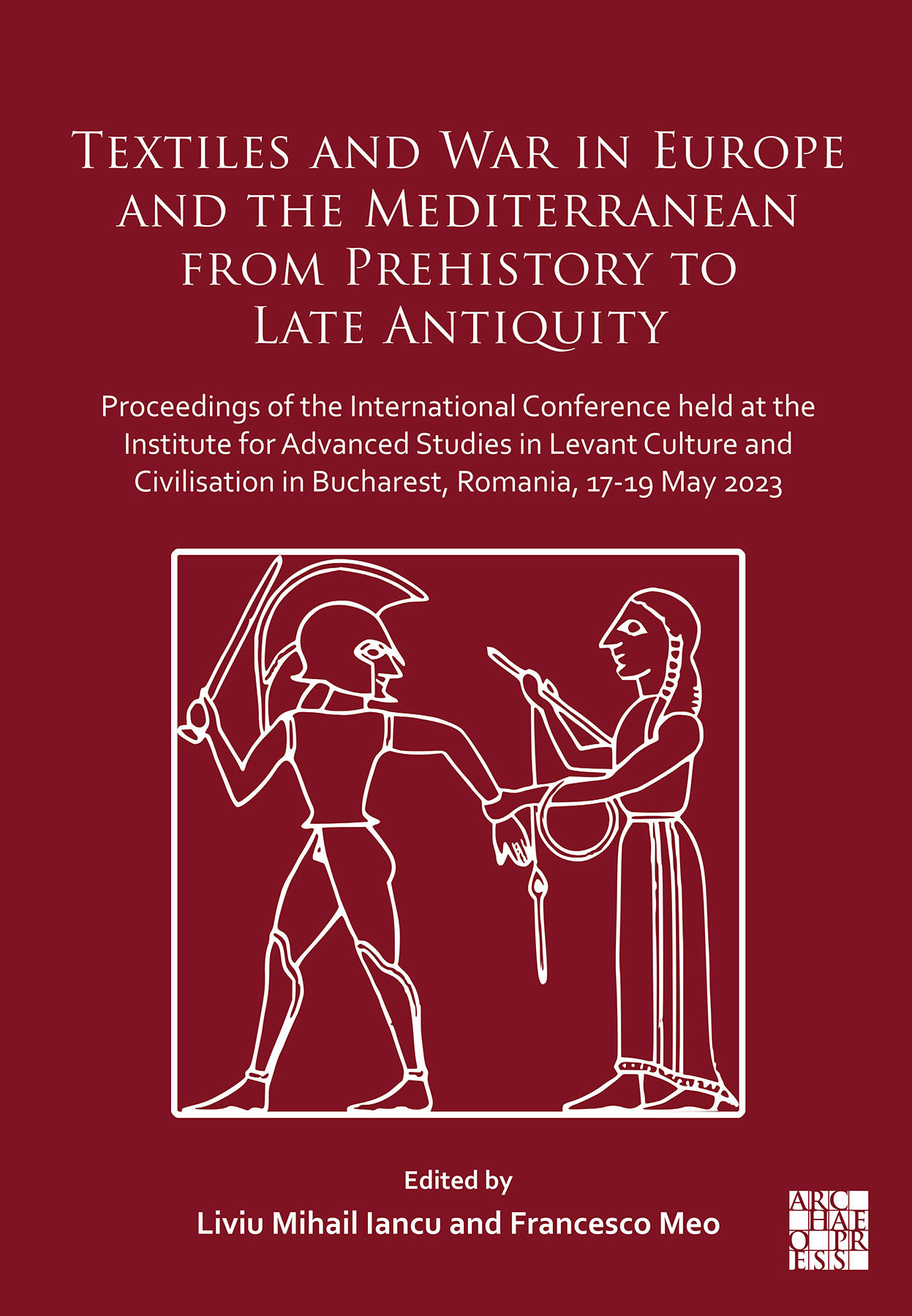
Download Sample PDF
H 290 x W 205 mm
238 pages
Published Aug 2025
ISBN
Hardback: 9781805830801
Digital: 9781805830818
Keywords
Arms; Armour; Costume; Dress; Greece; Iberia; Italy; Jews; Leather; Linen; Lining; Macedonia; Mesopotamia; Rome; Thrace; Textiles; War; Warfare; Wool
Related titles

Textiles and War in Europe and the Mediterranean from Prehistory to Late Antiquity
Proceedings of the International Conference held at the Institute for Advanced Studies in Levant Culture and Civilisation in Bucharest, Romania, 17-19 May 2023
Edited by Liviu Mihail Iancu, Francesco Meo

 Add to wishlist
This volume explores the role of textiles and leather in warfare from prehistory to late antiquity, examining production, acquisition, symbolism, and practical use. Studies draw on archaeological, iconographic, and written evidence from Iberia to Mesopotamia, with a focus on Greece, Rome, and the Italian peninsula.
Contents
Introduction
Textiles for War: Archaeological Evidence and Approaches – Margarita Gleba
Craft, Design and Ergonomics. Decorations, Reinforcements and Protections for Archaic, Classical and Hellenistic Panoplies Between the Mediterranean and the Black Sea – Raimon Graells i Fabregat
Protecting the Legionary’s Head: Analysis of the Evidence of Lining in Roman Helmets from the Imperial Age – Fabio Spagiari and Elisabetta Malaman
Textiles on the March: Textile Activities in Roman Republican Military Contexts of Western Iberia (1st Century BC) – Francisco B. Gomes, Teresa Rita Pereira, Carlos Pereira and João Pimenta
Reused and Recycled Textiles from Judean Desert Sites Associated with the Jewish Rebels Who Fought the Romans During the 1st and 2nd Centuries AD, Compared to Finds from Contemporary Nabatean Sites in Southern Israel – Orit Shamir
‘Quod Satis in Usum Fuit Sublato’. Booty and Tribute as Textile Supply Sources for Ancient Greek and Roman Armies – Liviu Mihail Iancu
Samnite Armour and Linen – Gianluca Tagliamonte
Typical Dress in Daunia (Puglia Region, Southern Italy) and Its Representation in Stone Carvings – Francesco Meo
Blood-Splattered Tunics: Textile Trophies in the Funerary Iconography of Campania and Lucania, Italy, in the 4th Century BC – Maureen Carroll
The Proto-Lucanian Hydria from the Tomb 2/1994 of Gravina-Botromagno and the Polysemy of Heroic Textiles: Symbola for the Peucetian Elites – Carlo Lualdi
From Milites to Augusti: the Adoption of Military Clothing in Depictions of Roman Emperors During the 3rd Century AD – Adrián Gordón Zan
Roman Soldiers or Others: Who Were the People Depicted on the Funerary Stelae from the Middle Strymon Valley? – Philip Kolev
Clothing on the Eastern Border of the Roman Empire: Parthian Military Costumes on Statues in the Museum of Şanlıurfa (ancient Edessa in Osrhoene) in Southeastern Turkey – Ergün Laflı and Maurizio Buora
About the Author
Liviu Mihail Iancu is Senior Researcher at the Institute for Advanced Studies in Levant Cultural and Civilisation in Bucharest, holding a PhD from the University of Bucharest on archaic Greek mercenaries. His studies focus on ancient Mediterranean warfare and the Greek colonisation in the Pontic region. His work on ancient textiles deals with the specialised economic systems for clothing the troops and the items captured as booty or received as tribute.
Francesco Meo is Assistant Professor of Italic Archaeology at the University of Salento, teaching Greek and Italic archaeology and art history since 2015. His research explores production activities in southern Italy during the first millennium BC and the influence of the Greeks of Magna Graecia over the neighbouring Italic tribes. His work on ancient textiles in southern Italy focuses on the reconstruction of the production system, including gender aspects, and the analysis of fabrics.

Archaeopress Publishing Ltd
First and Second Floor
13-14 Market Square
Bicester
Oxfordshire OX26 6AD
United Kingdom
Tel +44 (0) 1865 311914 | fax +44 (0) 1865 512231 | email info@archaeopress.com
