
Publishing Scholarly Archaeology since 1997
Publishing Scholarly Archaeology since 1997
Log in | My Account | Basket Twitter Facebook LinkedIn
Advanced Search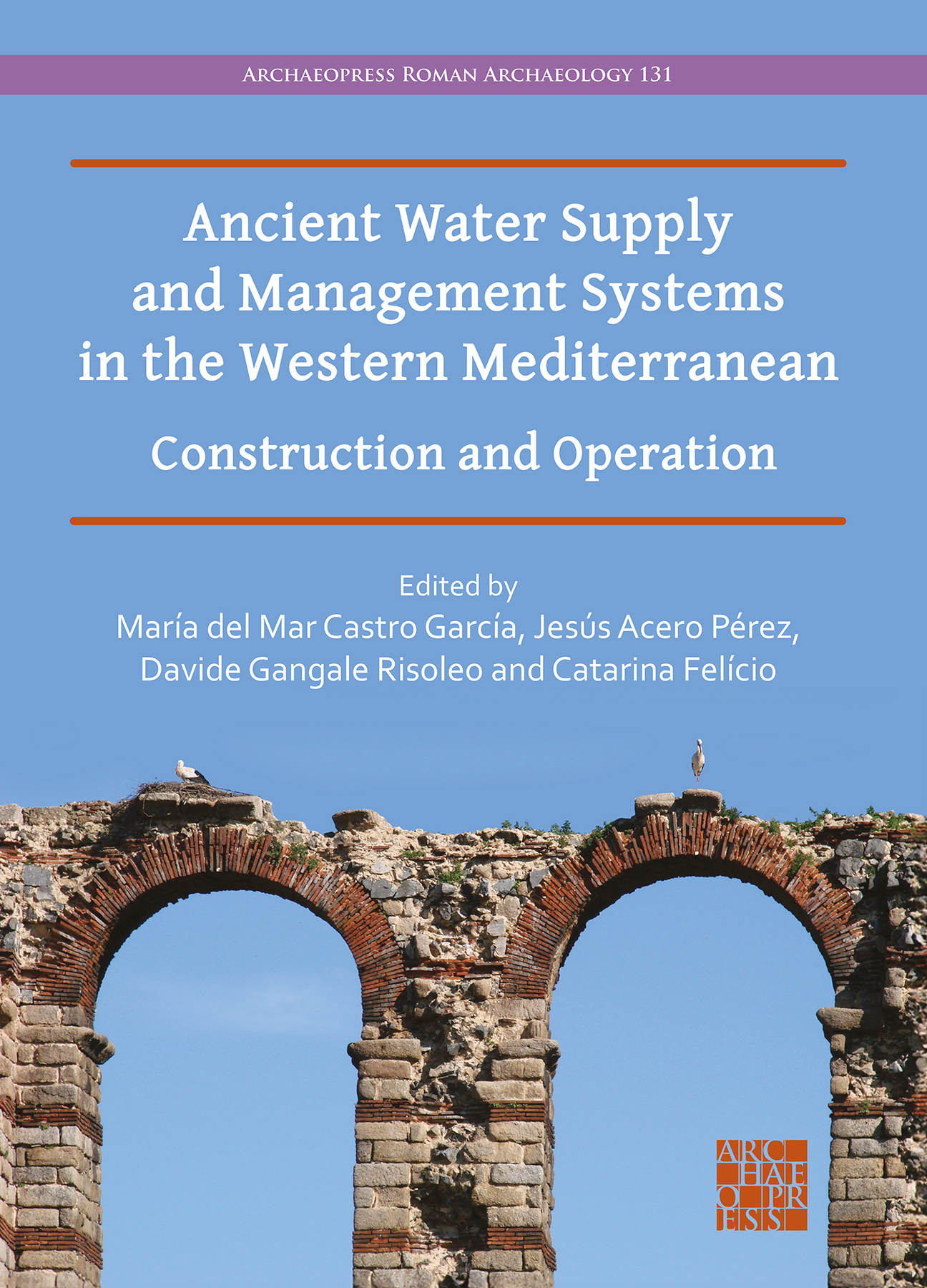
Download Sample PDF
H 276 x W 203 mm
226 pages
116 figures, 15 tables (colour throughout)
Published Dec 2025
ISBN
Paperback: 9781805830924
Digital: 9781805830931
Keywords
Roman Archaeology; Landscape Archaeology; Ancient Topography; Roman Hydraulic Technology; Urban Water Cycle; Ancient Waterworks
Related titles
Archaeopress Roman Archaeology 131
Ancient Water Supply and Management Systems in the Western Mediterranean
Construction and Operation
Edited by María del Mar Castro García, Jesús Acero Pérez, Davide Gangale Risoleo, Catarina Fel??cio

 Add to wishlist
This volume examines water management in Western Mediterranean settlements from the Iron Age to Late Antiquity. It explores infrastructures like aqueducts, wells, cisterns, and drainage systems, highlighting their role in survival, crafts, religion, and landscape transformation.
Contents
Introduction. Water Management in Roman Times: Continuity and Variability in Archaeological Studies ??? Mar??a del Mar Castro Garc??a
Water Usage at Mirobriga (Castelo Velho de Santiago do Cac??m, Portugal). An Overview of the Structures of Water Supply and Distribution ??? Catarina Fel??cio
Water Management in Calduba (Sierra Aznar, Arcos de la Frontera, C??diz): A Terraced System for the Recreation of a Locus Amoenus? ??? Isabel Rond??n-Sevilla, Jos?? Antonio Calvillo Ardila and L??zaro G. Lag??stena Barrios
Erogationes in the San L??zaro Aqueduct, M??rida? The ???House of the Amphitheatre??? Example ??? Macarena Bustamante-??lvarez, Elena H. S??nchez L??pez and Ana M. Bejarano Osorio
Monumental Fountains with Staircases at the End of the Iron Age in Southern Gaul ??? Sandrine Agusta-Boularot, Marc Bouiron, Gr??gory Vacassy and Ghislain Vincent
Water Management in a Roman Settlement at the Foot of the Alps: The Waterworks of Augusta Taurinorum ??? Davide Gangale Risoleo and Stefania Ratto
Water and the City of Veii: A Link between Mythology, Religion, Archaeology, and History ??? Ugo Fusco
The Underground Structures of the Theatre in Ostia: A Preliminary Study on the Sewerage System ??? Katerina Gottardo
The Villa Under the Lakes. Water Management of Nero???s Villa in Subiaco, Rome ??? Fabiana Tozzi
Late Antique Transformations in Water Provision, Management and Distribution in the Thermal Bath Archaeological Park of Baiae (Bacoli, Naples) ??? Gioconda Di Luca
Analysing the Water Supply to Roman Artisanal and Commercial Facilities: Pompeii as a Case Study ??? Elena H. S??nchez L??pez
Rainwater Collection and Storage in the Pompeian House: Slaves at Work ??? Gemma Jansen
Abellinum and its Water Distribution System: New Evidence for a Wider Comprehension of the Hydraulic Infrastructures ??? Marina Covolan and Daniela Musmeci
???Domesticating Water???: Some Conclusions on Water Infrastructure in the Ancient World ??? Jes??s Acero P??rez
About the Author
Mar??a del Mar Castro Garc??a, PhD at the University of C??diz, is a Ram??n y Cajal postdoctoral researcher at the Department of Prehistory and Archaeology, University of Granada. Her research interests include Roman water management, landscape archaeology, GIS analysis, and remote sensing.
Jes??s Acero P??rez, PhD in History at the University of Extremadura, has been a postdoctoral researcher, first at the Centre for Archaeology of the University of Lisbon (UNIARQ) and, since 2021, at the Department of Prehistory and Archaeology of the University of Seville. His scientific interests focus on urban planning, architecture, hydraulic engineering and waste management in Roman and Late Antiquity.
Davide Gangale Risoleo is an archaeological officer for the Ministry of Culture, working in the ABAP Superintendency for the provinces of Catanzaro and Crotone. He holds a PhD in Ancient Sciences and Archaeology from the University of Pisa and has been a research fellow at the University of Calabria. His research interests focus on the tradition of ancient topographical studies, with particular emphasis on the analysis of the relationship between water and urbanism.
Catarina Fel??cio, Archaeologist and Pre-Doctoral Researcher at CHAM - Centre for the Humanities/NOVA FCSH, works on Roman Architecture and Construction, focusing mainly on bath buildings, hydraulic architecture and sanitation.

Archaeopress Publishing Ltd
First and Second Floor
13-14 Market Square
Bicester
Oxfordshire OX26 6AD
United Kingdom
Tel +44 (0) 1865 311914 | fax +44 (0) 1865 512231 | email info@archaeopress.com
