
Publishing Scholarly Archaeology since 1997
Publishing Scholarly Archaeology since 1997
Log in | My Account | Basket Twitter Facebook LinkedIn
Advanced Search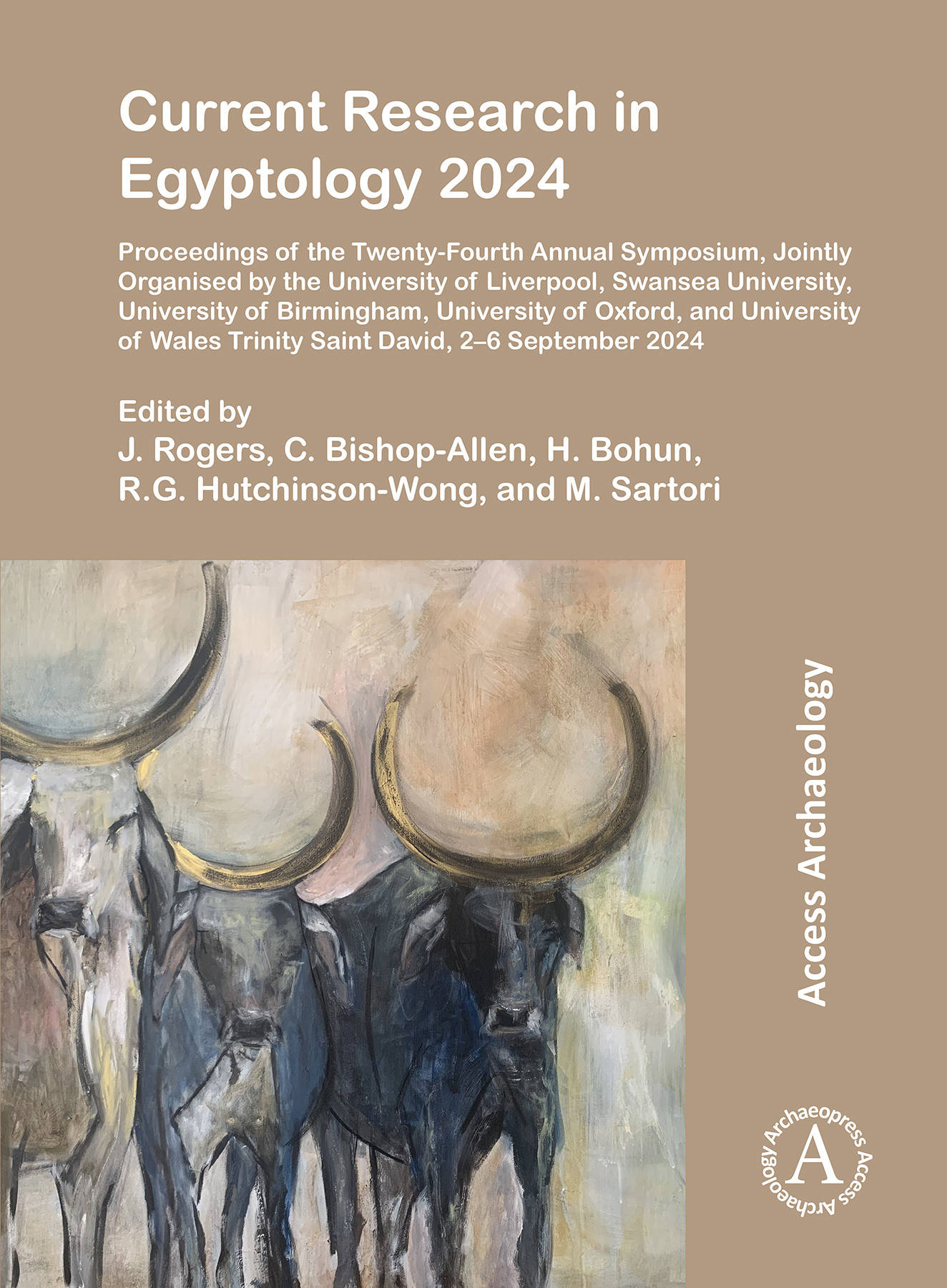
Download Sample PDF
H 276 x W 203 mm
460 pages
Illustrated in colour throughout
Published Sep 2025
Archaeopress Access Archaeology
ISBN
Paperback: 9781805831136
Digital: 9781805831143
Keywords
Ancient Egypt; Egyptology; Papyrology; CRE; Postgraduate conference
Related titles
Current Research in Egyptology 2024
Current Research in Egyptology 2024
Proceedings of the Twenty-Fourth Annual Symposium, Jointly Organised by the University of Liverpool, Swansea University, University of Birmingham, University of Oxford, and University of Wales Trinity Saint David, 2–6 September 2024
Edited by John Rogers, Catherine Bishop-Allen, Henry Bohun, Reuben G. Hutchinson-Wong, Marina Sartori

Paperback
£80.00
Includes PDF
PDF eBook
(personal use)
Free Download
PDF eBook
(institutional use)
£9.99
 Add to wishlist
23 selected papers from the twenty-fourth Current Research in Egyptology conference cover topics including discussion of material culture, society, religion, reception studies, findings from archaeological excavations, and methodological issues, collecting a wide range of recent research in Predynastic, Pharaonic, and Graeco-Roman Egyptology.
Contents
Introduction
Abbreviations
Organising Committee
Conference Volunteers
List of Keynote Lecturers
List of Paper Presentations
List of Poster Presentations
Ritual or Taphonomy? The Ritual Breaking of Predynastic Flint Knives – Mona Akmal M. Ahmed
Vignettes of the Book of the Dead on Third Intermediate Period Coffins from Thebes – Nagwa Alazraq
Women in the Workforce: A Gendered Division of Labour in Dynastic Egypt? – Jessica Coughtrey
The Cult of Sobek at Gebel el-Silsila – A Study of the Relief Scene Fragments
of the Recently Rediscovered Temple of Sobek of Kheny within the Context of New Kingdom Crocodile Cults – Joanne Derbyshire
From Souvenirs to Statements: A Study of ‘Mummy Photography’
at the Turn of the 20th Century – Marion Devigne
The One and the Many, and the ONE-TO-MANY: Data Models and Databases in Egyptology – Mona Dietrich
Naked Female Figurines in the Palace Area of Qantir: Sexual Images or Objects of Protection? – Sara Gebhardt
One Workmen Family from the Serapeum of Memphis Area – Amira Hamdy Mortaga
Replacing Deities: The Adaptation of Divine Triads by the God’s Wives of Amun
in Iconographic Reliefs (8th–6th Centuries BCE) – André Shinity Kawaminami
Exploring the Expression of Time and Memory in Decorated Ware Vessel Compositions through Experimental Archaeology – Sophia E. Kroft
A Lexical Study of the Theme of Creation in the Amarna Hymns – Laurianne Lancien
Early Egyptology: Beyond Nationalism? – Thomas Lebée
Multifaceted Religiosity: Reflections on the Use and Significance of Offering Tables
in the 1st Millennium BCE – Esmeralda Lundius
Shell Forehead Ornaments in Predynastic Egypt and the Southern Levant – Rachael Mayoh
The Eldest Sons of Re. Reconsidering a Royal Title – Julian Posch
ḏꜣjsw: The Personification of Creation Utterances – Shaimaa Saber
Enhancing Documentation and Communication for Preserving Cultural Heritage – Samar Saeed Abady Mohamed and Asmaa Hussein Abdelhamied
Colourant Pigments in Sudan, Nubia and Egypt in the Neolithic Period – Sakura Sanada
An Era of Perfection: The Vignettes of Book of the Dead Spell 17 in the Papyri
of Ramesside Period – Mykola Tarasenko
Banqueting with Tutankhamun: A Case Study in Determining the Function and Meaning of an Unprovenanced Artefact (ECM 1887) – Michael R. Tritsch
The Call of Nighted Khem: Tracing Ancient Egypt through Weird Fiction – Lawrence Webb
Regent or Ruler? Military Policy of Queen Ankhesenpepy II During the Early Years of Pepy II’s Reign – Olha Zapletniuk
Postface: ‘Art and Academia in Conversation’: Pushing the Boundaries of Interdisciplinarity in the Conference Space at Current Research in Egyptology 2024 – Henry Bohun
About the Author
John Rogers recently defended his PhD thesis at Swansea University, where his work was funded by a Research Excellence Scholarship. His research interests centre on power, authority, and legitimacy and their expression in diverse contexts in the mid-first millennium BCE, and he has participated in fieldwork in Luxor and Abydos since 2017.
Catherine Bishop-Allen is a PhD candidate at the University of Liverpool, holding a BA in Classical Civilisation and Egyptology, and an MA in Ancient Egyptian Culture, both from Swansea University. Her research interests include sensory approaches to the ancient world, environmental archaeology, and the impact of climate on hierarchical structures. In addition to her current research, she has participated in several archaeological missions in Egypt since 2019.
Henry Bohun holds an MA in Ancient Egyptian Culture from Swansea University; he is working on his PhD through the University of Wales Trinity Saint David, and is currently based at Trier University on a scholarship scheme.
Reuben G. Hutchinson-Wong is a postgraduate researcher at the University of Birmingham, funded by the Midlands4Cities Doctoral Training Partnership. He completed his MA, BA(Hons), and BA at Waipapa Taumata Rau University of Auckland, specialising in Ancient History and Geography. His research interests include looking at how ancient communities used tombs as ongoing sites of burial and the reception of ancient Egypt in Aotearoa New Zealand.
Marina Sartori is currently Teaching Associate at the Faculty of Asian and Middle Eastern Studies at the University of Oxford, where she also recently completed an SNSF-funded postdoc project centring on the use of colour in New Kingdom funerary manuscripts. She defended her PhD in 2022 at the University of Basel and as an epigraphist has been part of several excavations, such as the Swiss Mission in Sheikh Abd el-Qurna and the Polish Archaeological Expedition to the North Asasif.

Archaeopress Publishing Ltd
First and Second Floor
13-14 Market Square
Bicester
Oxfordshire OX26 6AD
United Kingdom
Tel +44 (0) 1865 311914 | fax +44 (0) 1865 512231 | email info@archaeopress.com
